



What percentage of body fat is needed to see abs? Guide for men and women
Let’s be honest: one of the reasons why most of us get into bodybuilding is to improve the appearance of our abs. Nothing beats perfectly shaped abs, whether on stage during a competition or simply when you look at yourself in the mirror. It’s almost like a badge of honor that shows you’re doing things right! But as you do crunching and Russian twists, have you ever wondered what percentage of body fat you need to see your abs?
Some of you may be surprised to learn that the answer depends on many factors, including your genetics, your sex, the areas in which your body stores fat primarily, and the development of your abdominal muscles, to name just a few.
Although your percentage of body fat can be a useful indicator, it should be noted that there is no magic formula that guarantees the appearance of impressive and perfectly-shaped abs.
In this article, we will therefore examine not only the numbers, but also the factors that actually play a role in defining the abdominals. We will also see how to achieve visible abdominals without compromising your overall health.
What percentage of body fat is needed to see abs?
So, what exact percentage of body fat should you have to achieve impressive abs?
In most people, the abdominals gradually become more developed and more visible as the percentage of body fat increases. Fat mass decreases. However, the level of visibility of the abdominals varies considerably from person to person.
As a guide, in men, the definition of the abdominal area usually begins to become visible with a percentage of body fat of between 12 and 15%, while a more pronounced definition of the six-pack usually appears around 10 to 12% of heavy mass.
In women, the values are different. Defined abs can appear with a fat mass percentage between 20 and 24%, while a six-pack generally becomes more visible with a percentage between 16 and 20%.
It is important to clarify that these ranges are only approximations and do not constitute universal objectives guaranteeing a precise result.
Some people may have visible abdominal muscles with a higher percentage of body fat, while others will need to reduce their body fat even more before achieving a clearly visible abdominal definition and a more toned appearance.
Ultimately, fat distribution, the thickness of the abdominal muscles, and genetics all play an essential role in how quickly a person can achieve well-defined abs.
It is also important to understand that trying to systematically reach the lowest level of the fat mass ranges mentioned above is not necessarily the most sustainable or healthiest goal to pursue.
Why do fat mass percentages differ between men and women?
If you are wondering why the percentage of body fat differs between men and women, the main reason lies in the natural differences in body composition.
Women generally have a higher percentage of body fat, mainly due to hormonal and reproductive functions.
Comparing a man’s fat mass percentage directly with that of a woman can therefore be misleading.
Moreover, if one woman seeks to reduce her body fat At extremely low levels in order to achieve a six-pack, she may experience a decrease in her energy level as well as disruptions in her menstrual, hormonal, and reproductive cycles.
Men can also experience a decrease in their energy level when their fat mass percentage becomes very low.
When it comes to working to achieve well-defined abs, the goal should therefore not be to obsessively pursue a specific fat mass number, but rather to maintain a healthy fat mass level while developing the definition of the abs.
Why do some people have well-defined abs with a high percentage of fat mass?
It is not uncommon to find two people who have completely different appearances while having a similar percentage of body fat.
This is explained by the fact that the percentage of body fat only represents a part of the whole.
Fat distribution and genetics
The storage of fat in your body is strongly influenced by your genetics, which also determines the areas of your body that tend to be drier than others.
For example, some people tend to retain more fat around the waist while losing fat in the abdomen.
The reality is simple: you cannot precisely choose the areas in which your body decides to lose fat.
Development of abdominal muscles
Don’t forget that your abs are muscles too, just like your biceps, shoulders, or pectorals.
The thickness and volume of your abdominal muscles therefore influence their visibility under the skin.
When your abs are well developed, they are more likely to be visible than a less developed abdominal belt, even though both people have a similar percentage of body fat.
An abdominal structure that varies according to individuals
The connective tissues divide the large right side of the abdomen and create that sought-after six-pack look for many bodybuilders.
However, the arrangement of these connective tissues varies from person to person.
This means that the structure and shape of your abdomen are also influenced in part by your genetics.
Although training undoubtedly allows you to develop your abs, it cannot change their basic anatomical structure.
Lighting and water retention
The appearance of your abdominal muscles can also be influenced by your posture, your recent meals, the lighting, and your level of hydration.
That is why, even when your body composition does not change much, your abs may appear slightly more visible in one photo than in another, even if the two photos were taken on the same day.
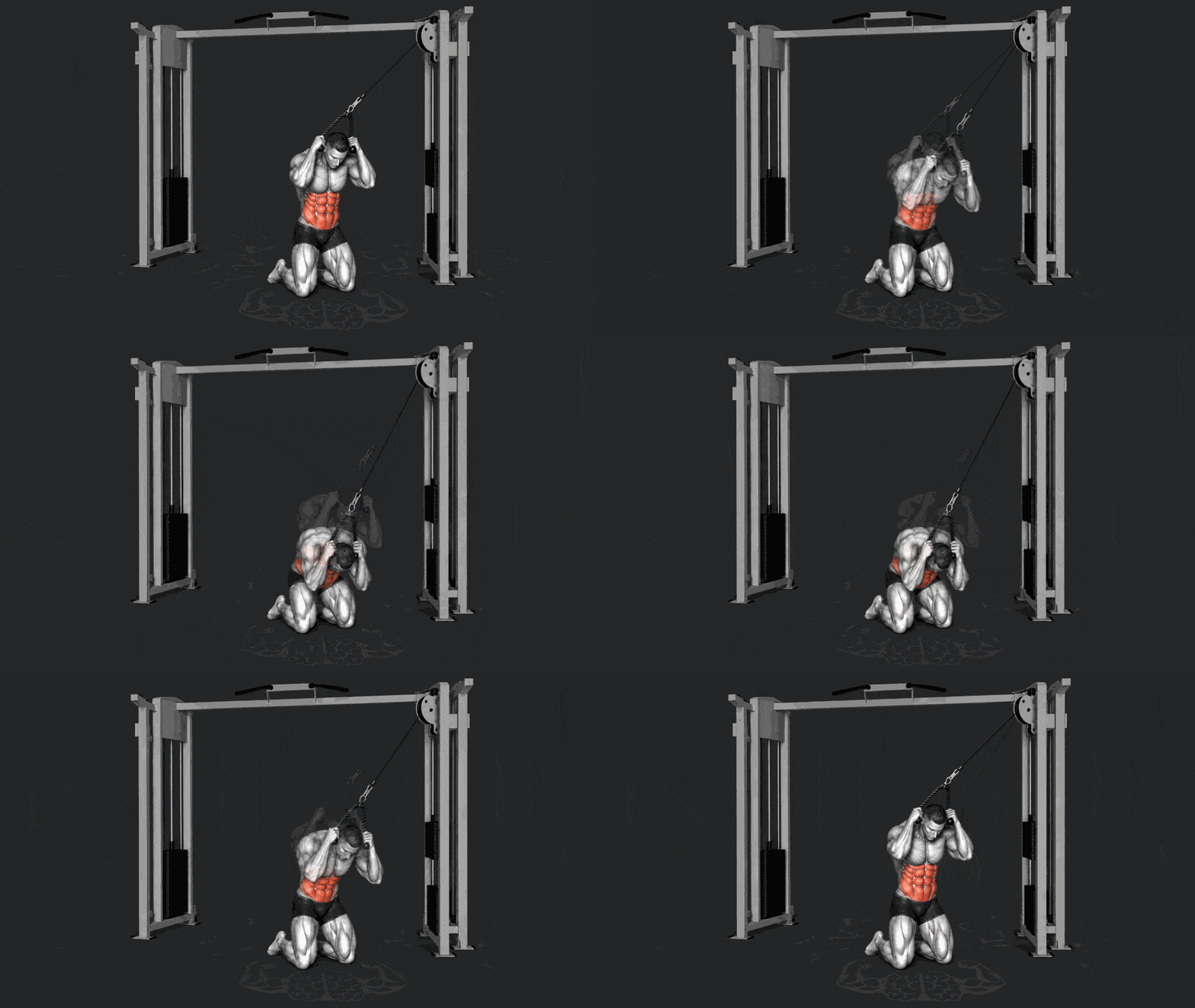
How to lose fat mass and develop the muscles of the abdominal girdle?
If your physical goal is to develop visible and well-defined abs, you must focus on developing your muscle mass while reducing excess body fat.
To achieve this, start by maintaining a sustained caloric deficit.
To lose fat, you need to adopt a diet that allows you to consume fewer calories than your body spends over a certain period.
Start with a moderate, not excessive, caloric deficit.
An excessively large deficit would make it much more difficult to maintain an exercise routine, proper recovery, and muscle development.
You should also develop the habit of monitoring your progress and adjusting your calorie intake accordingly.
The next step is to consume an adequate amount of protein. This macronutrient helps to preserve your lean muscle mass and supports the repair of micro-ruptures that appear in muscle tissue following exercise.
You can, for example, consume foods rich in protein such as:
- lean meat;
- the chicken;
- the fish;
- the eggs;
- the beans;
- the dairy products.
Once your calorie deficit is established and your protein intake is sufficient, you must then incorporate the best exercises for the abdominal muscles.
You can, for example, create different variations of crunches, such as:
- the inverse crunches;
- the pulley crunch;
as well as other effective exercises for the abdominals such as:
- the abdominal wheel roll-outs;
- the suspended knee records.
Focus on proper execution and impeccable technique, because the quality of the movement is more important than the number of repetitions you are able to perform.
Over time, you can gradually increase the number of repetitions while maintaining perfect technique to increase the tension exerted on your abs.
However, an abdominal training routine should not prevent you from continuing your regular muscle-building sessions.
Resistance training helps preserve your muscle mass while promoting the development of a stronger and more muscular physique.
Also, don’t forget to include cardio in your routine to get a balanced workout.
Once your diet and training are properly structured, be sure to optimize your recovery by prioritizing quality sleep.
Try to sleep between 8 and 9 hours per day to promote optimal recovery after your demanding workouts.
It is during your sleep that your body regenerates and the processes of muscle development occur.
Conclusion
As a rule, the percentage of fat mass that allows the abdominal muscles to be seen is located around 10 to 15% in men and 16 to 24% in women, Depending primarily on individual characteristics and the level of abdominal definition desired.
Nevertheless, the appearance of well-defined abdominals does not depend solely on achieving these fat mass values.
It also depends on your genetics, the distribution of your fat, your body composition, and the development of your abdominal muscles.
If you are determined to develop a well-defined abdominal girdle, it is therefore advisable to combine your abdominal exercises with progressive resistance training, an appropriate diet, sufficient recovery, and quality rest.
Leave a Reply
You must be logged in to post a comment.